There are a number of Aquatic Invasive Species which are becoming a problem in the UK. They have generally been introduced more recently than their terrestrial peers but are increasing rapidly and so it is important to catch them now to prevent further spread.
They were introduced as plants for contained aquatic environments to do specific jobs such as oxygenation; however they are released in to the wild by the public due to lack of knowledge.
The key species that the Environment Agency is concerned with at present are:
Australian Swamp Stonecrop (Crassula helmsii)
Parrots Feather (Myriophyllum aquaticum)
Floating Pennywort (Hydrocotyle ranunculoides)
Why are they a problem?
Aquatic environments are fragile ecosystems and our options for control are severely limited, so protection of these environments from aggressive invasive species can be difficult.
They are a threat to biodiversity, monopolising local environments and out competing native species.
They disrupt the ecosystems degrading them severely and impeding flow in vital drainage channels thus causing flooding.
How to identify them?
Links to third-party websites that provide detailed information on Aquatic Invasive Species
Buddleia (Buddleija davidii) is a perennial woody species, introduced into the UK in the late 19th Century, which has become rampant in urban environments.
It is known as the Butterfly Bush and continues to be planted in gardens to attract insect life but once it has jumped the wall it can cause havoc. If allowed to develop unchecked it can over run industrial land such as along railways, on development land and derelict plots.
How to identify Buddleia
Buddleia Young Seedling
Buddleia Large Plant
Buddleia Flowering
Buddleia Leaves
Buddleia FlowerHead
Why is it a problem?
It can spread rapidly, growing anywhere and can be difficult to control unless treated as a specific problem.
Raise your line of sight in any UK city and you can see it growing out of walls and chimneys. Whilst growing in these locations it is not only difficult to access but also degrading the integrity of the surface it is growing on.
Infrastructure maintenance companies have started to take a more proactive approach as the problems that Buddleia causes have been recognised and the cost of remedial measures realised,
Rhododendron (Rhododendron ponticum) is another plant introduced to the UK during the 19th Century by the Victorian Horticulturalists.
It was planted in gardens but more crucially planted as cover for game birds on Sporting Estates and it is probably the later which accelerated this species break in to the wild.
It is a much greater problem in Western Regions, where the mild and moist climate suits it perfectly, and has infested native and commercial woodlands in a devastating fashion, as it is highly tolerant of shade and is able to grow in as little as 2% light.
How to identify Rhododendron
Rhododendron Large Plant
Rhododendron Leaves
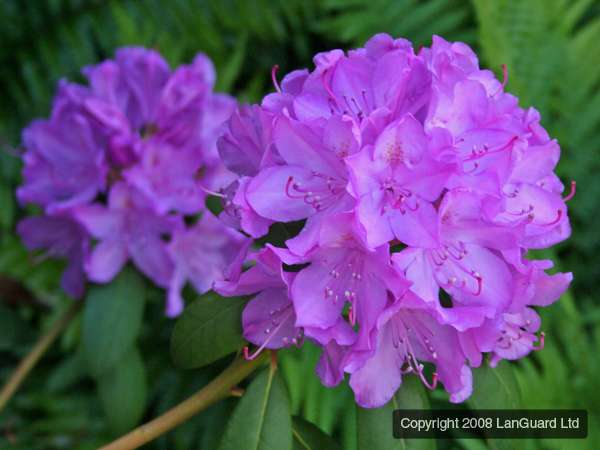
Rhododendron Flower Head
Why is it a problem?
It can be difficult to control forming dense impenetrable thickets that are difficult to treat, and is a threat to biodiversity, out-competing native species and monopolising local environments; Rhododendron exudes phenolic chemicals into the soil around them to suppress competing vegetation.
It is a particular problem invading ancient native woodlands which are fragile ecosystems which become unable to regenerate.
Comments Off on Rhododendron (Rhododendron ponticum)
Common Ragwort (Senecio jacobaea) is a native species and so therefore not strictly an invasive species, however it is convenient to deal with it in this section as it shares many of the problems of the invasives.
Like invasive species it is best targeted as a specific problem. It is spread throughout the UK and has become a particular problem in transport corridors where it’s uncontrolled spread has led to a number of high profile campaigns by the British Horse Society.
Common Ragwort is a biennial plant, meaning it completes it’s lifecycle over 2 years, growing from seed to rosette in the first year and rosette to flowering in the second.
Flowering Ragwort is an all too familiar site on the UK transport infrastructure from July through to October but the plant is best tackled when it is less visible at the rosette stage.
Many areas have proactive ragwort strategies in place that keep the plant in check but this is another plant that thrives on neglect.
How to identify Common Ragwort
Common Ragwort Young Rosette
Common Ragwort Large Rosette
Common Ragwort Flowering
Common Ragwort Leaves
Common Ragwort Flowerhead
Common Ragwort Flowerhead Seeded
Why is it a problem?
Ragwort plants contain Pyrolizidine Alkaloids (PAs) which are highly toxic to grazing animals particularly horses.
These PAs cause irreversible liver damage and the effect is cumulative so it can build up over a number of years. It is estimated that Ragwort poisoning is responsible for 2000-6000 horse deaths per year.
Recent research has suggested that Humans are also vulnerable to PA poisoning, PAs can be absorbed through the skin so plants should not be handled with bare hands and the pollen also contains PAs which can be inhaled which is also to be avoided.
Common Ragwort is scheduled under The Weeds Act 1959 and The Ragwort Control Act 2003, the later yielding a Code of Practice for Controlling Ragwort and a Code of Practice for Disposing of Ragwort. Copies of this legislation are available fromDEFRA’s mini-site on Common Ragwort .
Horsetail (Equisetum arvense) is a bushy perennial with a rhizomatous stem formation. Not a non-native invasive species, but included it in this section as a problem species, which can be difficult to control. As a result, it is beneficial to take a similar approach that you would take with an invasive species, to achieve adequate control.
Horsetail is a primitive plant, related to ferns, and does not have the complex transport systems, found in higher plants, so often thrives in wet locations. To counter act it’s poor water transport system, it has evolved a thick waxy cuticle that contains a lot of silicon, to reduce water loss caused by transpiration. Both the poor transport system and the thick waxy cuticle make this plant difficult to control with a traditional herbicide strategy. It one of the few plants in the UK that glyphosate based formulations struggle to control.
Horsetails are among the earliest vascular plants. They evolved over 300 million years ago and dominated the Carboniferous Period. Their deaths and later compaction helped create the coal deposits. They are non-flowering plants that do not have seeds or fruits, but they reproduce via spores, produced by specialised structures produced early in the growing season.
How to identify Horsetail
Horsetail – Early season spore production
Horsetail – Thriving mid-summer
Horsetail – ‘Bottle brush’ shoots early season
Horsetail – Dominating highway verge – early season
Horsetail – Growing through tarmac
Horsetail – Summer stem close up
Why is it a problem?
Horsetail is a problem because it is difficult to control using traditional strategies, mechanical or chemical. Where conditions suit the plant, it prefers wet locations, it can dominate the vegetation almost becoming a monoculture in places. As a native plant this is not always a problem but as can be seen in the pictures above it can impede drainage and is quite capable of growing up through light weight tarmac surfaces such as footpaths, car parks or driveways.
Himalayan Balsam (Impatiens glandulifera) is another horticultural specimen that was introduced in the 19th Century, 1839 to be precise that has since escaped to become nuisance in the wild.
It is the tallest annual in the UK growing up to 3 metres and is an attractive plant with a distinctive purple pink flower, which has led to the slang name of ‘Policeman’s helmet’.
Each plant can produce up to 800 seeds which are explosively released when the seed pods are mature, capable of projecting the seeds 7 metres. This is a highly effective dispersal method which enables the plant to rapidly colonise the damp and riparian habitats that the plant favours. The seeds may be further spread by water and can remain viable for 2 years.
How to identify Himalayan Balsam
Himalayan Balsam Young Cotyledon
Himalayan Balsam Carpet Effect
Himalayan Balsam Flowering
Himalayan Balsam Stem
Himalayan Balsam Flower
Why is it a problem?
It is a threat to biodiversity out competing native species and monopolising local environments. On riverbanks, once it has died back, the area is vulnerable to erosion in the winter.
Giant Hogweed (Heracleum mantegazzianum) is the next best know invasive plant in the UK after Japanese Knotweed. Both were introduced as spectacular horticultural specimens and spread to all the best Victorian gardens during the 19th Century Giant Hogweed also managed to jump the wall and it is now widespread throughout the British Isles where it frequently colonises riverbanks.
However this is where the similarity ends, Giant Hogweed is a perennial plant that can grow for up to 4 years before flowering. The flowering spike can extend to 5 metres, producing a white umbrella like flower which can be 0.5 metres across. Each plant can produce 50,000 seeds, which can remain viable for up to 15 years. These seeds are spread locally and large distances in water as well as by human intervention.
How to identify Giant Hogweed
Giant Hogweed Young Rosette
Giant Hogweed Large Rosette
Giant Hogweed Flowering
Giant Hogweed Leaves
Giant Hogweed Stem
Giant Hogweed Flowerhead Seeded
Why is it a problem?
Giant Hogweed presents a serious public health threat, the stems and leaves are covered with small hairs coated with poisonous sap. Even the slightest touch can cause painful blisters and severe skin irritation. The symptoms can take a couple of days to develop, the skin becomes highly photosensitive producing large watery blisters however the effects can be long lasting, with contact resulting in recurrent dermatitis. This is a particular concern for small children who may use the stems as pea-shooters or pretend telescopes resulting in horrific injuries.
It is a threat to biodiversity out competing native species and monopolising local environments. On riverbanks once it has died back in the winter the area is vulnerable to erosion.
It is scheduled in the Wildlife & Countryside Act 1981 and the Environmental Protection Act 1990.
Japanese Knotweed (Fallopia japonica) has developed a well deserved reputation for being the most invasive plant in the UK.
It was first introduced to the UK in 1825 and spread to all the best Victorian gardens as a spectacular horticultural specimen. However by 1905 it had jumped the wall and was recorded on the spoil heaps of South Wales and since then it has spread the length and breadth of the country.
Its success is even more remarkable when it is realised that it has become such a menace without setting viable seed. The majority if not all the plants in the UK are clones of the first specimens imported, all the plants are female and need to be fertilised by a male plant which thankfully was never introduced. This means that this plant has spread by vegetative means alone obviously with the ignorant collusion of man.
How to identify Japanese Knotweed
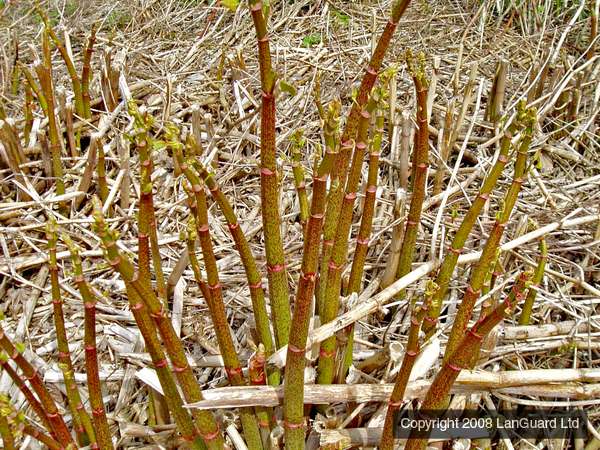
Japanese Knotweed Spring
Japanese Knotweed Summer
Japanese Knotweed Winter
Japanese Knotweed Flowering
Japanese Knotweed Leaves
Japanese Knotweed Seeds
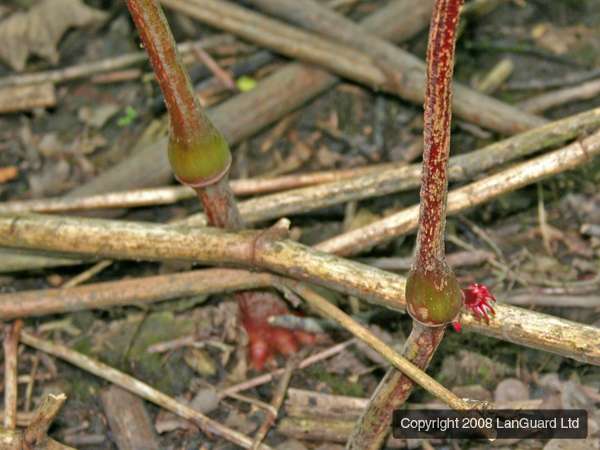
Japanese Knotweed Stems
Japanese Knotweed Rhizome
Why is it a problem?
It is difficult to control and can spread rapidly, it is capable of regenerating from small fragments of rhizome which are transported easily by modern development practices.
It is can cause damage to urban infrastructure, growing through tarmac and breaking concrete.
It is a threat to biodiversity out competing native species and monopolising local environments.
On riverbanks once it has died back in the winter the area is vulnerable to erosion.
It is scheduled in The Wildlife & Countryside Act 1981 and The Environmental Protection Act 1990.
Invasive and problem weeds often spread rapidly, degrading the biodiversity and wildlife value of an area. Once established they can be difficult to eradicate, particularly in sensitive habitats. We have over 35 years Invasive Weed Management experience and have developed rigorous programmes for their control. There is no ‘silver bullet’ treatment, but LanGuard VM have the knowledge and the experience to put together smart invasive weed management plans, that meet our customers needs. Why not contact us to see if we can help you?
It is the infamous Japanese Knotweed that can grow through tarmac and concrete destroying our urban infrastructure, which has grabbed the headlines and most people know as an invasive weed. As with most weeds an understanding of the ecology and a sensible approach can solve most invasive weed problems, even Japanese Knotweed!
LanGuard VM is a leading specialist vegetation management business, providing a well respected and reliable service to our clients throughout the UK, from our regional bases.
Our experienced team of professionals will work with you to develop a suitable invasive weed management plan tailored to meet your needs, whether it is a carefully targeted herbicide spray in an environmentally sensitive situation or a large multi functional, time critical project on development land.
Invasive Weed Species found in the UK
There is an ever increasing list of invasive species in the UK, though compared to other countries, we have been relatively lucky that the list has not been a lot longer. The Wildlife & Countryside Act 1981 has been amended over the years, but Schedule 9, the section that includes invasive weeds, has dramatically increased in the most recent amendments. The current list of non-native invasive weed species, listed in Schedule 9 – March 2015, has reached 50 or more species. Some of the categories have been expanded, for instance Japanese Knotweed is now listed alongside Giant Knotweed and Hybrid Knotweed. However, other familiar species remain on the list Giant Hogweed, Himalayan Balsam and Rhododendron and there is there is an ever longer list of aquatic plants included as well.
Ragwort, though a native species, is worthy of inclusion in this section; its toxicity to grazing animals is such that it boasts new UK Invasive Weed Legislation detailing its control – The Ragwort Control Act 2003. Common Ragwort is not an a non native invasive species, but is often described as an Injurious Weed, as it is listed in The Weeds Act 1959.
Comments Off on Invasive Weed Management
We use cookies on our website to give you the most relevant experience by remembering your preferences and repeat visits. By clicking “Accept All”, you consent to the use of ALL the cookies. However, you may visit "Cookie Settings" to provide a controlled consent.
This website uses cookies to improve your experience while you navigate through the website. Out of these, the cookies that are categorized as necessary are stored on your browser as they are essential for the working of basic functionalities of the website. We also use third-party cookies that help us analyze and understand how you use this website. These cookies will be stored in your browser only with your consent. You also have the option to opt-out of these cookies. But opting out of some of these cookies may affect your browsing experience.
Necessary cookies are absolutely essential for the website to function properly. These cookies ensure basic functionalities and security features of the website, anonymously.
Cookie
Duration
Description
cookielawinfo-checkbox-analytics
11 months
This cookie is set by GDPR Cookie Consent plugin. The cookie is used to store the user consent for the cookies in the category "Analytics".
cookielawinfo-checkbox-functional
11 months
The cookie is set by GDPR cookie consent to record the user consent for the cookies in the category "Functional".
cookielawinfo-checkbox-necessary
11 months
This cookie is set by GDPR Cookie Consent plugin. The cookies is used to store the user consent for the cookies in the category "Necessary".
cookielawinfo-checkbox-others
11 months
This cookie is set by GDPR Cookie Consent plugin. The cookie is used to store the user consent for the cookies in the category "Other.
cookielawinfo-checkbox-performance
11 months
This cookie is set by GDPR Cookie Consent plugin. The cookie is used to store the user consent for the cookies in the category "Performance".
viewed_cookie_policy
11 months
The cookie is set by the GDPR Cookie Consent plugin and is used to store whether or not user has consented to the use of cookies. It does not store any personal data.
Functional cookies help to perform certain functionalities like sharing the content of the website on social media platforms, collect feedbacks, and other third-party features.
Performance cookies are used to understand and analyze the key performance indexes of the website which helps in delivering a better user experience for the visitors.
Analytical cookies are used to understand how visitors interact with the website. These cookies help provide information on metrics the number of visitors, bounce rate, traffic source, etc.
Advertisement cookies are used to provide visitors with relevant ads and marketing campaigns. These cookies track visitors across websites and collect information to provide customized ads.